

Coffee Robot Repays Its €43,450 Cost in 5.4 Months, Not the 3.3 Its Model Predicts
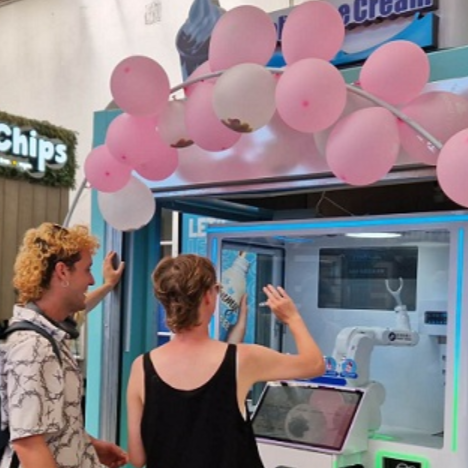
SHENZHEN, GUANGDONG, CHINA, October 16, 2026 -- A robotic coffee deployment in Madrid repaid its €43,450 investment in 5.4 months, against the 3.3 months the same unit's month-eight cash flow implies — and Moocoo, a Shenzhen-based supplier of robotic beverage systems, is publishing the full eight-month record to argue that the sector should quote the first number, not the second.
The company is proposing a standard it calls ramp-adjusted payback: payback measured against the net profit an operator actually receives while volume is still climbing, rather than against the steady-state run rate the machine eventually reaches. The difference between the two — the ramp gap — was 2.1 months in the Madrid record, or 64% longer.
The same unit, measured two ways
The unit opened at 87 cups a day in its first month and reached 185 by its eighth. Net profit ran from €5,731 in month one to €13,274 in month eight, and cumulative net profit reached €76,940 across the period.
Apply the month-eight rate of €13,274 a month to the €43,450 investment and the unit repays in 3.3 months. Measure the same investment against the profit the operator actually banked, and it repaid in 5.4 months. The gap is 2.1 months — equivalent to €29,252 of profit the unit would have produced across eight months had it opened at its eventual volume.
Month one traded at 47% of the unit's eventual run rate. The first three months produced €19,887 of the eight-month total: 26% of the profit, from 38% of the trading period.
The itemised month-by-month record, including the €965 a month of fixed cost that does not move with volume, is published in the Madrid AI coffee robot case study.
Why the gap is the risk, and the machine is not
The hardware did not change between month one and month eight. What changed was footfall capture, the venue's trading calendar, and how quickly customers formed the habit. Those are the variables an operator can still influence before signing a lease — and they are exactly the variables a steady-state model holds constant.
"The ramp is where the operator's cash is actually exposed, and it is the only part of the model they can still influence before they sign," said David Chen, VP of International Sales at Moocoo. "We would rather publish 5.4 months and explain the two-month gap than quote 3.3 and let a customer discover the difference on their own."
Chen added: "Ramp-adjusted payback is not a harder calculation. It is the same model with the ramp left in. Any operator can produce it from their own first four months of sales — and a vendor who will not is telling you something."
Four questions that expose a steady-state model
Moocoo is recommending that buyers put four questions to any supplier quoting a payback figure:
What month-one volume is assumed, and what evidence supports it?
What is the payback at that month-one volume, rather than at run-rate?
Which operating costs are fixed, and which scale with volume?
What happens to the payback if month one lands at half the assumption?
The full cost structure behind the Madrid record, itemised line by line, is set out in the coffee robot cost and ROI analysis, and the same structure modelled across five volume scenarios appears in the European coffee robot ROI benchmark. The hardware itself and its operating sequence are described at the AI coffee robot page and in how it works.
Methodology
The figures cover one unattended deployment in a central Madrid shopping centre, operated by an independent third party who is not employed by Moocoo. Data was supplied by the operator from his own sales and cost records and has not been independently audited. Revenue is stated before tax. Net profit is after location commission, consumables, restocking labour, utilities, insurance and a maintenance reserve. Payback is calculated against total initial investment of €43,450, including hardware, shipping, customs, installation and initial inventory.
Ramp-adjusted payback is calculated from cumulative net profit at the actual monthly volumes recorded. Steady-state payback applies the month-eight net profit of €13,274 to the same investment. The ramp gap is the difference between the two, in both time and cumulative cash.
The 5.4-month figure refines the preliminary payback stated in Moocoo's September 2026 release, which was based on a shorter trading record. A single deployment is not an industry average.
About Moocoo
Moocoo supplies certified robotic beverage hardware and adds the branding, sourcing, site selection, operations and support that turn it into an operating business. Its coffee, bubble tea, ice cream and bartender systems run in more than 60 countries on a platform carrying CE, FCC and ISO 9001 certification and more than 70 patents covering robotic arm precision, AI recipe management and cloud fleet operations. Moocoo Technology is based in Shenzhen, China.
Moocoo Technology
Shenzhen Moocoo Technology Co., Ltd
+852 6903 1935
info@moocoo.com
Legal Disclaimer:
EIN Presswire provides this news content "as is" without warranty of any kind. We do not accept any responsibility or liability for the accuracy, content, images, videos, licenses, completeness, legality, or reliability of the information contained in this article. If you have any complaints or copyright issues related to this article, kindly contact the author above.
